

What is malaria; and what causes it?
- The malaria parasite is transmitted to humans through the bite of the female Anopheles mosquito.
- Malaria is one of the world’s major infectious diseases, more than 200 million new cases of malaria are reported each year.
- If malaria is not treated timeously and correctly, it can prove to be fatal
The World Malaria Report, the World Health Organization’s flagship malaria publication, highlights the following progress towards global targets:
- In 2018, an estimated 228 million cases of malaria occurred worldwide, compared with 251 million cases in 2010.
- The incidence rate of malaria declined globally between 2010 and 2018, from 71 to 57 cases per 1000 population at risk. However, from 2014 to 2018, the rate of change slowed dramatically, reducing to 57 in 2014 and remaining at similar levels through to 2018.
- In 2018, there were an estimated 405,000 deaths from malaria globally, compared with 416,000 estimated deaths in 2017, and 585,000 in 2010.
- In 2018, only the WHO African Region and the WHO South-East Asia Region showed reductions in malaria deaths compared with 2010. The WHO African Region had the largest absolute reduction in malaria deaths, from 533 000 in 2010 to 380 000 in 2018. Despite these gains, the malaria mortality reduction rate has also slowed since 2016.
- Globally, the elimination net is widening, with more countries moving towards zero indigenous cases: in 2018, 49 countries reported fewer than 10,000 such cases, up from 46 countries in 2017 and 40 countries in 2010.
- Paraguay and Uzbekistan were certified by WHO as malaria free in 2018, while Algeria and Argentina will be achieving certification in early 2019.
- In 2016, WHO identified 21 countries with the potential to eliminate malaria by the year 2020. WHO is working with the governments in these countries – known as “E-2020 countries” – to support their elimination acceleration goal.
Despite this success, 2018 still witnessed 405,000 malaria deaths. The 2019 World Malaria Report shows that after an unprecedented period of success in global malaria control, progress has stalled. Data from 2014–2018 highlight that no significant progress in reducing global malaria cases was made in this period.
We must not become complacent, or this tremendous progress will be reversed. Malaria remains a major cause and consequence of poverty – disproportionally affecting women and children. Eliminating and ultimately eradicating the disease would vastly improve the lives of many vulnerable families in the developing world, helping to lift them out of poverty.
The Global technical strategy for malaria 2016–2030, approved by the World Health Assembly in May 2015, sets ambitious but achievable targets for 2030. This strategy seeks to reduce the disease burden and eliminate malaria – objectives that are closely linked to several of the sustainable development goals, which call for action by all countries, poor, rich and middle-income to promote prosperity while protecting the planet.
Source for all other figures: World Malaria Report 2019
The WHO African Region continues to carry a disproportionately high share of the global malaria burden. In 2016, the region was home to 90% of malaria cases and 91% of malaria deaths. Some 15 countries – all in sub-Saharan Africa, except India – accounted for 80% of the global malaria burden.
The 10 highest burden countries in Africa reported increases in cases of malaria in 2017 compared with 2016. Of these, Nigeria, Madagascar and the Democratic Republic of the Congo had the highest estimated increases, all greater than half a million cases.
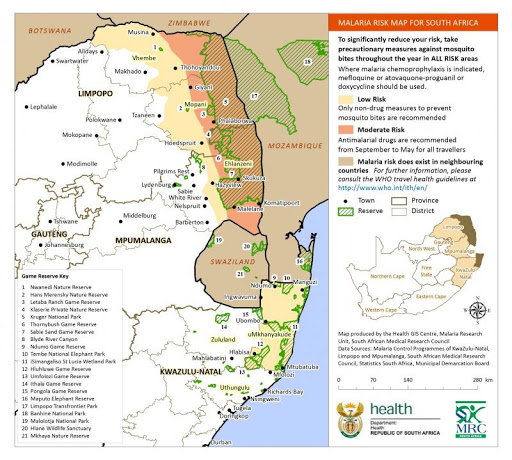
Malaria risk map for South Africa shown above
© Copyright BUGZAWAY